
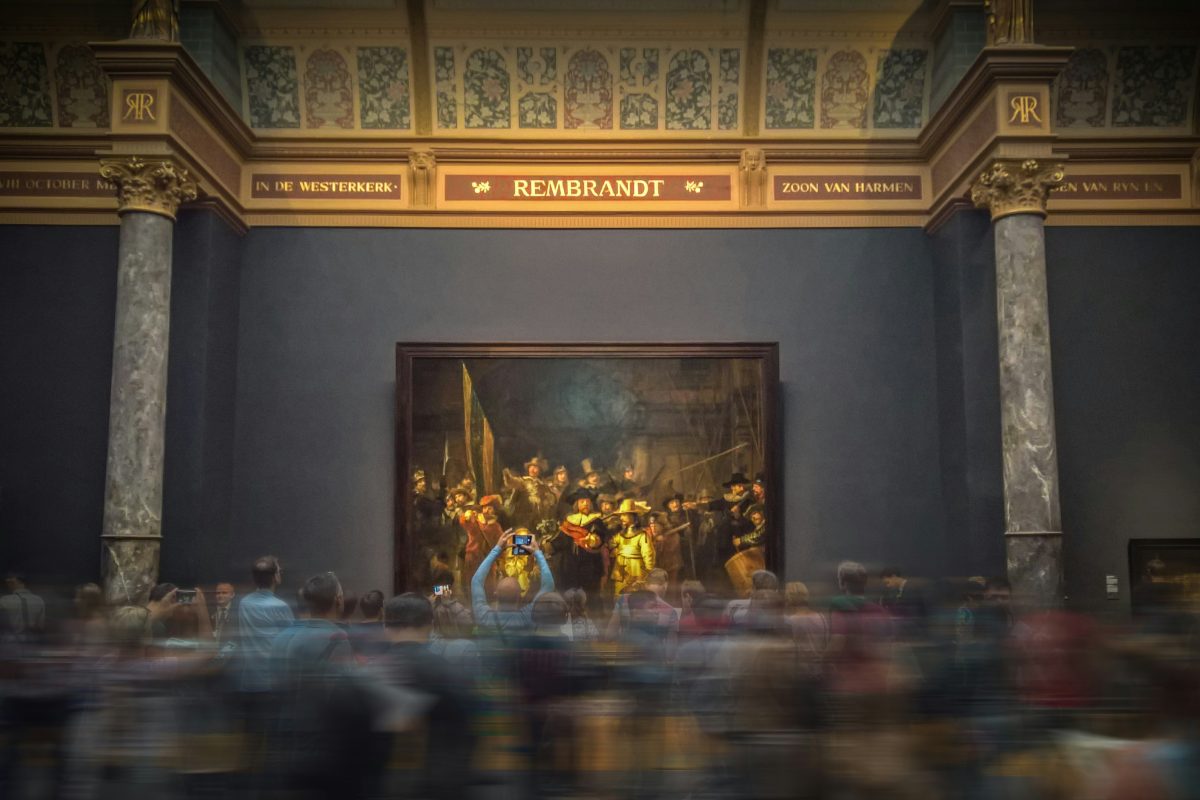
 Václav Pluhař via Unsplash
Art history continues to surprise us at times when we least expect it. Even with masters that have been studied for centuries, the past still preserves areas of shadow ready to come to light again. Such is the case right now in Amsterdam, where the Rijksmuseum attributes a painting from 1633 to Rembrandt van Rijn. The painting remained out of the official catalog for more than 60 years.
The work, now recognized as authentic, was set aside in 1960 and disappeared from public view ever since. Now it's re-emerging, with a clear name and a clearly defined historical context.
'The Vision of Zacharias in the Temple': a work from 1633
The painting is titled 'The Vision of Zacharias in the Temple', a work from 1633, when Rembrandt was just 27 and establishing his reputation in Amsterdam. The scene depicts the episode from the Gospel in which priest Zacharias receives the announcement of the birth of his son John the Baptist.
Archangel Gabriel does not appear in physical form: his presence manifests itself through a bright beam of light that breaks through from above, an element that directs the gaze and builds the entire narrative tension. This theatrical and symbolic handling of light is one of the hallmarks of the young Rembrandt.
The year 1633 falls in a crucial phase of his career. After moving to Amsterdam, the artist expanded his clientele and refined a visual language that was already highly recognizable. During these years he developed an exceptional capacity for psychological introspection and a treatment of light that carves faces out of the darkness, as it were.
Why it had been dropped from the catalog
For decades the painting was considered questionable, and in 1960 it was removed from the official list of Rembrandt's works. After that, it remained in a private collection, out of museum circulation and virtually forgotten.
The turnaround came when the current owner contacted the Rijksmuseum, opening the door to new research. From then on, a meticulous process began that combined historical source research, stylistic comparison and scientific analysis.
Experts from the Rijksmuseum subjected the work to sophisticated scans, pigment analyses, research into the structure of the paint layer and dendrochronology of the wooden panel. The studies confirmed that the materials used correspond to the 1629-1633 period.
This revealed characteristics typical of Rembrandt's creative process: compositional revisions, variations in the effect of light and a pigment use that is in line with other certain works from the same period. The quality of the touch and the construction of the volumes were also found to correspond convincingly. Comparison with work by contemporaries strengthened the attribution and gave the painting a precise place within the master's early phase.
A public return after more than half a century
After more than 65 years of invisibility, the painting has been entrusted to the Rijksmuseum as a long-term loan and will be included in the permanent presentation. The discovery expands the oeuvre of an artist from whom some 350 works are known and offers new leads to better understand the development of his imagery during his early Amsterdam years.
Each new attribution changes the way we look at such a thoroughly studied artist. In this case, the rediscovery sheds light on a phase still in flux, in which Rembrandt is experimenting with light and narrative solutions that will later become central to his mature work. European art heritage continues to surprise us. And when the name Rembrandt is in play in the history of Western painting, every detail is given specific weight.
Source: Rijksmuseum
(©GreenMe.it 2026 / Managing Editor: Selma Keshkire - The Press Junction /Picture: Václav Pluhař via Unsplash)