
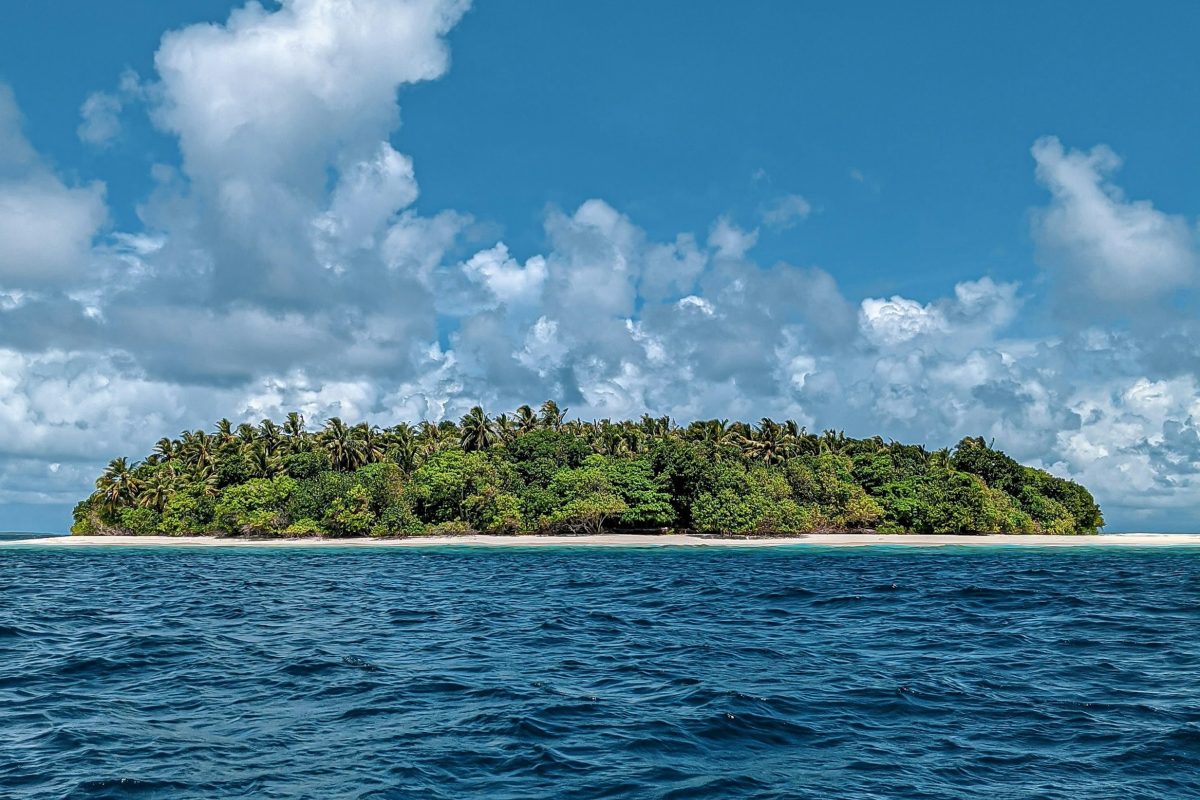
 ©Unsplash
In the heart of the Pacific, there's a place that illustrates better than any speech how political decisions can outlive their own authors. It's a story of Cold War legacies, hasty choices, radioactive contamination and climate crisis.
A legacy that today is cracking under the impact of rising sea levels. This structure is known as the Runit Dome in the Marshall Islands. The locals call it 'The Tomb'. It's a name that's not based on folklore, but on an acute awareness of what it contains.
The dome is located on the Enewetak atoll, at the bottom of a crater created in 1958 by the 'Cactus' nuclear test. Seen from the air, it appears as a perfectly circular concrete disc, some 115 metres wide, resting on the white sand like a gigantic lid. Beneath this 45-centimetre-thick cover, more than 111,000 cubic metres of soil and radioactive debris have been buried.
This is the residue of American nuclear tests carried out in the Pacific between 1946 and 1958. Among the substances present is plutonium 239, an extremely toxic isotope with a half-life of 24,100 years. An tiny quantity can be lethal.
The dome was born as a quick solution to an immense problem. It was built between 1977 and 1980, during the Enewetak clean-up operation, just as the United States was preparing to grant independence to the Marshall Islands. The stated aim of the project was to secure the area before the handover.
In reality, it was a hasty, economic choice. The crater chosen to contain the contaminated material rests on a porous, permeable coral bedrock, already cracked by previous atomic explosions. The structure has no watertight lining at its base. The concrete was poured on a floor that communicates directly with the ocean.
The story of the Runit Dome has its roots in the immediate post-war period. After the Second World War, the United States gained control of the Marshall Islands as a United Nations Trust Territory. The official mission was to protect the inhabitants.
Between 1946 and 1958, however, 67 atmospheric nuclear tests were carried out. The total energy released was equivalent to around 1.6 Hiroshima bombs per day for twelve consecutive years.
The atolls of Bikini and Enewetak were evacuated and turned into firing ranges. In 1954, the 'Castle Bravo' test, a 15-megaton H-bomb, proved a thousand times more powerful than Hiroshima. Radioactive fallout affected inhabited atolls such as Rongelap and Utrik. Declassified documents show that the authorities knew the direction of the winds.
Children played under a rain of radioactive ash mistaken for snow. Secret medical studies, such as Project 4.1, were carried out on the exposed population.
For years, pollution control remained a secondary concern. In the 1970s, as independence approached, the United States organized the clean-up operation. Some 6,000 veterans took part in the clean-up, often without adequate protection. Many handled contaminated debris with their bare hands, breathing in radioactive dust. The authorities claimed that the risks were minimal, comparable to a dental X-ray.
Many veterans subsequently developed cancer, degenerative bone disease and other serious pathologies.
The Runit Dome shows visible cracks. The concrete is deteriorating. Seawater is seeping in through the unsealed base, and the underlying water table is rising and falling with the tides, carrying contaminants into the Enewetak lagoon.
The U.S. Department of Energy acknowledges this seepage, but claims that the additional impact is negligible. According to this approach, the lagoon is already contaminated by decades of nuclear testing.
Politically, the question remains open. In 1986, the United States and the Republic of the Marshall Islands signed the Compact of Free Association. Washington considers this agreement to be the final closure of the claims. Since the dome is located on sovereign Marshallese territory, responsibility would fall to the local government.
The Marshall Islands authorities dispute this interpretation. They argue that crucial information about the faulty design and the true extent of the contamination was overlooked during negotiations. One element revealed in the following years particularly struck public opinion: the dome would contain only 1% of the plutonium dispersed on the atoll. The remaining 99% is in the lagoon sediments.
Rising sea levels pose a real threat to the Marshall Islands, which are made up of very low-lying atolls. The Runit Dome was built at sea level, without taking future climate scenarios into account. Even today, during storms, heavy swells break over the edges of the structure.
A particularly violent typhoon, fuelled by warmer ocean waters, could permanently compromise the dome. In an extreme scenario, radioactive material would be dispersed into the Pacific Ocean. For local communities, nuclear contamination is a daily reality. Cancer rates are higher than average. Traditional food resources are compromised, leading to dependence on imported products and a rise in diabetes and obesity.
Structural solutions exist: a vast, watertight containment system could be built over the current dome, or the radioactive materials could be removed and transferred to a secure storage site. Both options are costly and, for the time being, there are no concrete plans for either.
So the Runit Dome remains, exposed to the sun and the tides, a symbol of an unsettled nuclear legacy and a disputed international responsibility. Climate change is only accelerating the bill, which has remained unpaid for over half a century.
(©GreenMe.it 2026 / Managing Editor: Selma Keshkire - The Press Junction / Picture: ©Unsplash)