
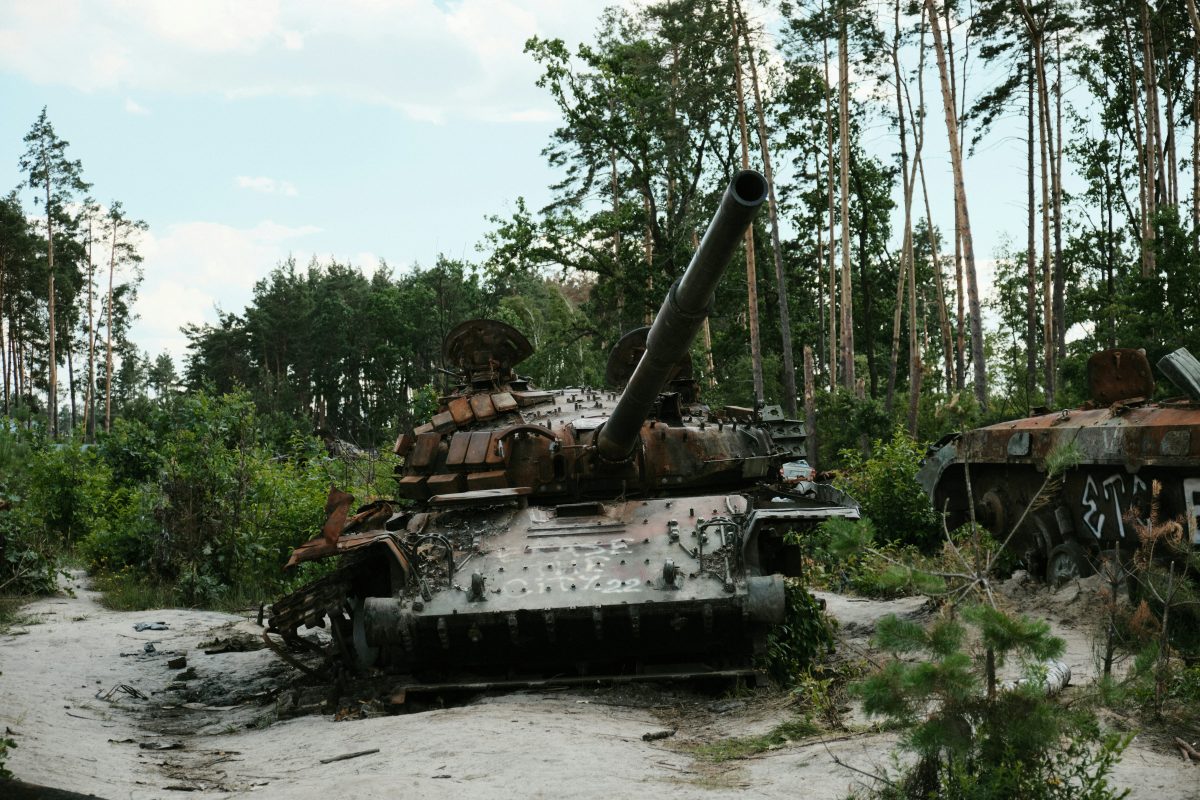
 ©Alex Fedorenko via Unsplash
On February 24, 2022, the Russian invasion of Ukraine definitively marked a profound break in Europe's sense of security. For weeks, the conflict preoccupied all media, captured the public's attention, and brought words thought to have been relegated to the past back to the forefront: occupation, siege, resistance, mass graves. Today, four years later, the war continues as ferociously as ever, but our perspective has changed. The war in Ukraine has become something familiar.
The emotional distance hasn't stopped growing. News flash by us, one after the other, superimposed on other emergencies. The daily suffering of an entire country has become a permanent backdrop. A habit that risks turning into denial.
War in the background
At first, every advance or retreat on the front seemed decisive. The images of Boutcha, Marioupol and Irpin left a scar in the collective memory. Today, although the intensity of the fighting has not diminished, the space devoted to the conflict has shrunk, carried away by an increasingly saturated and volatile flow of information.
Yet on the ground, the situation remains dramatic. The Guardian describes a war that has entered a phase of attrition: Russia's advance is proceeding at a snail's pace, but at the cost of colossal losses, while Ukraine continues to resist, retaking parts of its territory and keeping its strategic infrastructures operational. "The Kremlin is trying to impose the narrative that Ukraine is on the brink of collapse. This image is false," Christina Harward of the Institute for the Study of War told the British daily.
This narrative dimension is by no means secondary. Vladimir Putin's war is also a war of propaganda: a systematic construction of internal consent that presents the conflict as an existential defense by Russia, erasing any capacity for political action in Ukraine and reducing any opposition to treason. This communication device enables the Kremlin to maintain cohesion on the home front, normalize violence and absorb the shock of human losses.
Meanwhile, the bombardment of civilian infrastructure continues. Millions of people face winters without heat or electricity, hospitals and schools function intermittently, and entire urban areas remain deprived of essential services. This constant pressure on the population is designed to break down resistance even before military defences can be overcome.
Democracy fatigue
At the same time, fatigue is spreading throughout the West. In Italy, as shown by a SWG poll quoted by Adnkronos, support for Ukraine remains in the majority, but it appears more fragile, shot through with uncertainty and pessimism. Confidence in a rapid diplomatic solution is waning, along with the feeling that the conflict is destined to drag on and on.
This climate reflects a broader dynamic: Western democracies are struggling to sustain a political, economic and military commitment of this scale over the long term. This is where the Russian leader is playing the long game. His strategy is aimed not only at territorial conquest, but also at wearing down European societies, by exploiting their weariness, political divisions and social fragilities. Before being military, it's a war of psychological resistance, seeking to make support for Ukraine appear an unbearable cost.
In the columns of The Conversation, some experts speak openly of a stalemate. The parties involved have sufficient resources to continue fighting, but not enough to achieve a decisive victory. The result is a protracted war, exhausting economies, societies and political systems. A war which, precisely because it no longer produces spectacular turning points, slips to the margins of public attention.
Addiction as a collective risk
The greatest danger is not only geopolitical. It's cultural. Getting used to war means normalizing it, accepting daily destruction as part of the media landscape. It means ceasing to wonder about the long-term consequences: the environmental impact of bombing, soil contamination, the devastation of ecosystems, generations growing up between shelters and power cuts.
Today, Ukraine is a profoundly transformed country: A militarized society, an economy geared to the war effort and millions of displaced people both inside and outside the country. A situation that concerns not only Kiev, but the entire continent. This war has already reshaped Europe's energy, industrial and strategic priorities, accelerating transitions and opening up political rifts that are destined to last.
To continue to tell the story is not to run after the emergency, but to prevent it from being forgotten. For when war ceases to frighten us, it also ceases to challenge us. The risk then is that habituation becomes indifference, leaving violence to perpetuate itself in silence.
(...) One question remains unanswered: are we still prepared to really look at what is happening in the heart of Europe? As long as we continue to experience this war as foreign and distant, its uproar will only get closer.
(©GreenMe.it 2026/Managing editor: Selma Keshkire - The Press Junction/Picture: Alex Fedorenko via Unsplash)