
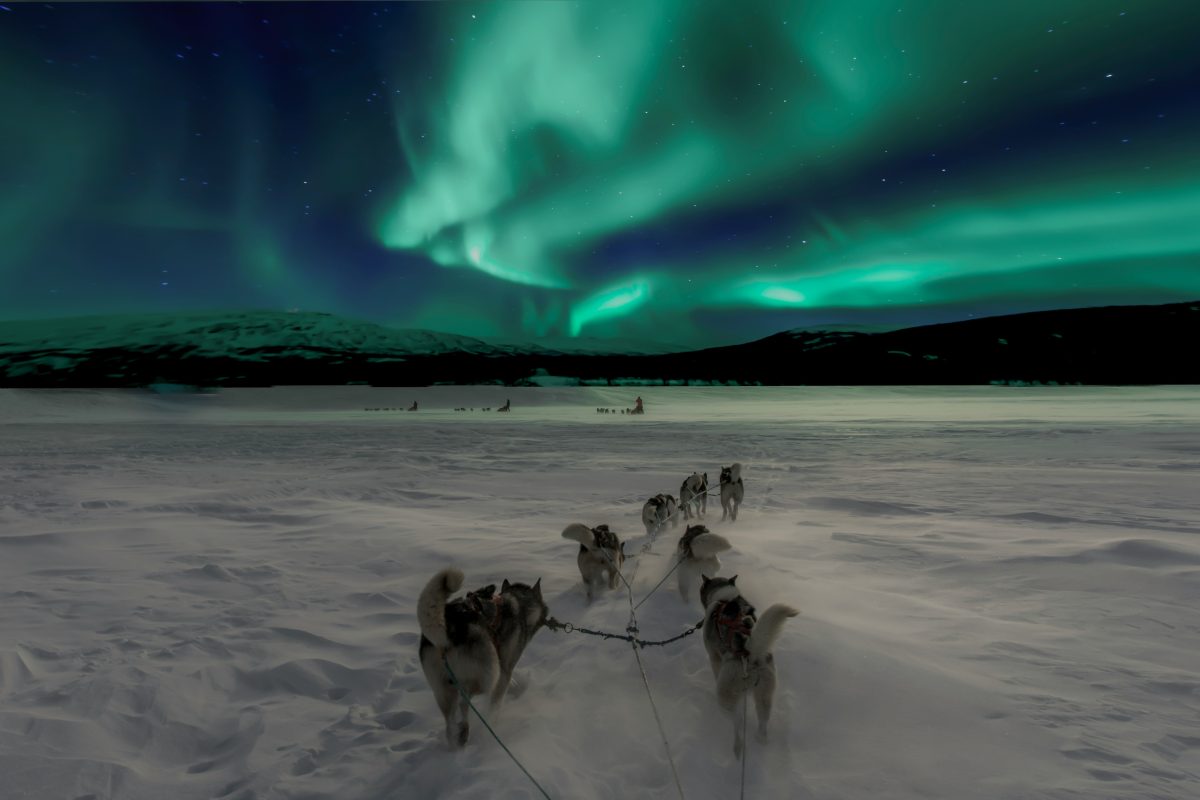
 ©Thomas Lipke via Unsplash
The thaw in Norway continues to unearth surprising fragments of the past. This time, in the mountains to the west of the country, the retreating ice has brought to light an imposing reindeer-hunting structure dating back some 1,500 years, hidden and protected by the cold for over fifteen centuries. The discovery fascinates archaeologists, but also raises troubling questions about the acceleration of climate change.
The discovery in the Aurland mountains tells the story of how Iron Age communities hunted reindeer using organized techniques, complex structures and surprising attention to material detail.
The site is located in the Aurland Highlands, in the heart of the mountains of western Norway, at an altitude of over 1,400 metres. Here, melting ice has revealed hundreds of worked birch trunks and branches, arranged to form two long, converging barriers. These are said to have guided herds of wild reindeer towards a vast final enclosure. A true collective 'hunting machine', designed to channel the animals into a restricted space where they were slaughtered with spears and arrows.
The discovery began almost by chance, when a local hiker noticed some strange wooden remains outcropping next to a patch of snow. It was then that a team of archaeologists from Bergen University Museum and the Vestland County authorities began to work in Vestland County, and came face to face with one of the largest wooden capture systems ever documented in Europe.
A pre-viking hunting system
Analyses indicate that the structure dates back to the mid-6th century AD, pre-dating the Viking era. In the vicinity of the enclosure, piles of reindeer antlers showing clear traces of cutting were uncovered, irrefutable proof of a slaughter carried out on site. This detail suggests intensive, planned hunting, fundamental to the economy of surrounding valleys such as Aurland and Lærdal.
Alongside the main structures, the thaw also yielded a small but valuable set of remains: iron spearheads, arrow shafts, fragments of wooden bows and personal objects linked to hunting activities. Among these is a clothing brooch carved from reindeer antler in the shape of a small axe, most probably lost by a hunter during the operation. An object that archaeologists describe as exceptional, as it would have been difficult to preserve under ordinary conditions.
Even more enigmatic is the discovery of a decorated pinewood oar, found among the trunks far from the fjords. Its presence in the high mountains remains without definitive explanation, and opens up new hypotheses on the symbolic or ritual value of certain objects used during the hunt.
From protective cold to global warming
The site's exceptional preservation is linked to an ancient climatic change. After its use, the area entered a cooling phase that led to freezing of the structure, rendering it unusable but preserving it in an ideal cold, damp environment. Today, paradoxically, it's global warming that's causing it to reappear, while at the same time threatening its survival.
Once exposed to air and sun, old wood begins to deteriorate rapidly. For this reason, the most fragile relics have been transferred to the Bergen museum's freezers, where they will be slowly dried and treated to prevent decomposition, while the metal objects will undergo specific anti-corrosion treatment.
A discovery that enriches science and sends out a clear warning signal
This find is part of a long series of discoveries linked to the thaw in Norway, which in recent years has brought to light skis, sandals, tools and objects from Roman and Viking times. Every summer becomes a race against time to document what emerges before it disappears.
At the same time, this find helps us to better understand the millennia-old relationship between human populations and reindeer, a link now under strain from habitat fragmentation and increased human activity in the mountains. What was protected by ice for centuries now survives only thanks to the speed archaeologists work, while the ice that was thought to be eternal continues to retreat.
(©GreenMe.it 2026/Managing editor: Selma Keshkire - The Press Junction/Picture: Thomas Lipke via Unsplash)