
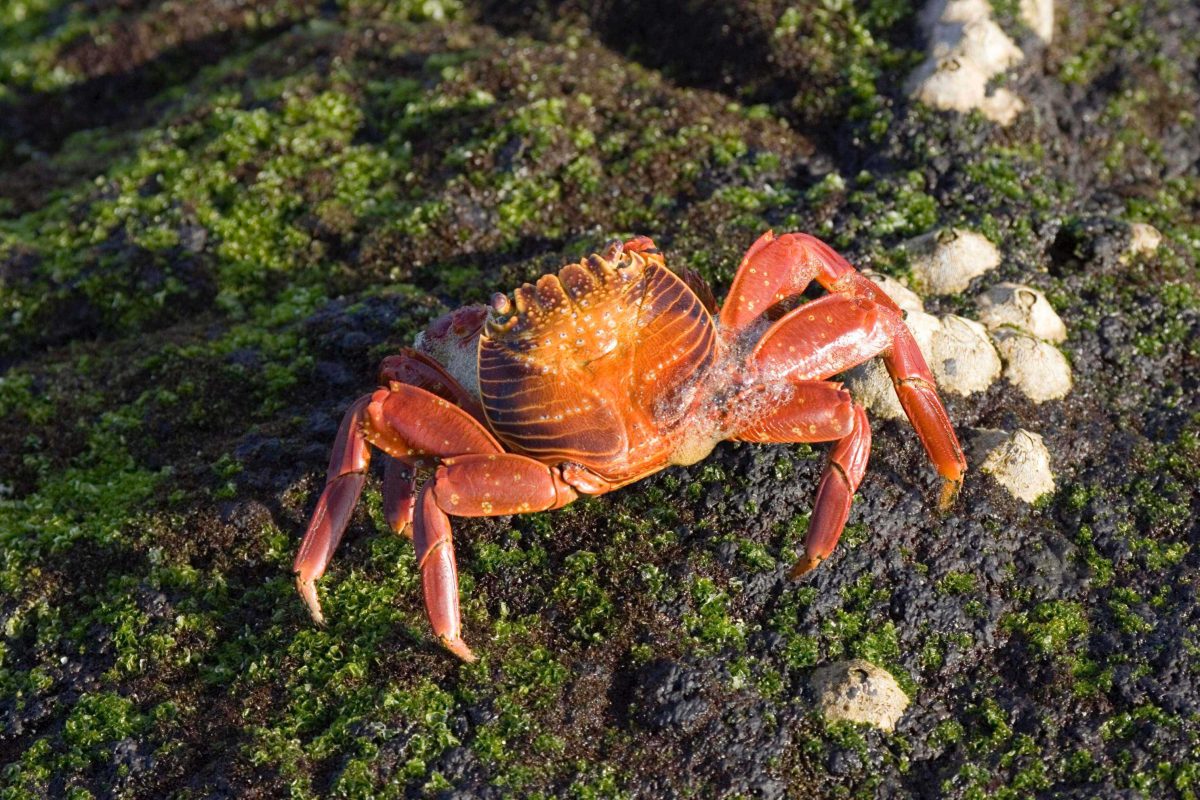
 © picture alliance / imageBROKER | Malcolm Schuyl/FLPA
Scientists have found new clues about how crabs developed their distinctive lateral movement.
A new study, published as a Reviewed Preprint in eLife, brings together the largest dataset to date on how crabs propel themselves. The analysis shows that lateral walking in 'true crabs' (Brachyura) can be traced back to a single evolutionary origin in a common ancestor, some 200 million years ago
The Brachyura are the largest group within the ten-armed crustaceans. Lateral movement has the advantage of making it easier for them to evade predators because they can quickly get away sideways. This may have allowed them to evolve in different habitats, from the deep sea to land.
Japanese research
The team led by lead researcher Yuuki Kawabata of Nagasaki University in Japan, filmed a specimen of 50 species of real crabs for 10 minutes in arenas that mimicked their habitat. The team combined the data with a previous phylogeny of 344 species (simplified to 44 genera). By doing this, they mapped behavior onto an evolutionary family tree.
Of the 50 species, 35 walked sideways and 15 walked forward. Lateral locomotion was found to have evolved once at the base of Eubrachyura (advanced true crabs), from a forward walking ancestor. This trait persisted stably.
Benefit of lateral locomotion
The researchers hypothesize that this one-time transition to lateral movement played an important role in the success of true crabs. Moving sideways allows crabs to move quickly in both directions, making their trajectory more unpredictable and making it easier for them to escape predators.
Side-walking could be a rare evolutionary innovation found primarily in true crabs, and possibly in some other groups, such as crab spiders and dwarf cicadas, according to the scientists. The researchers estimate that side-walking in true crabs originated about 200 million years ago.
Picture: © picture alliance / imageBROKER | Malcolm Schuyl/FLPA