
 ©PA
©PA
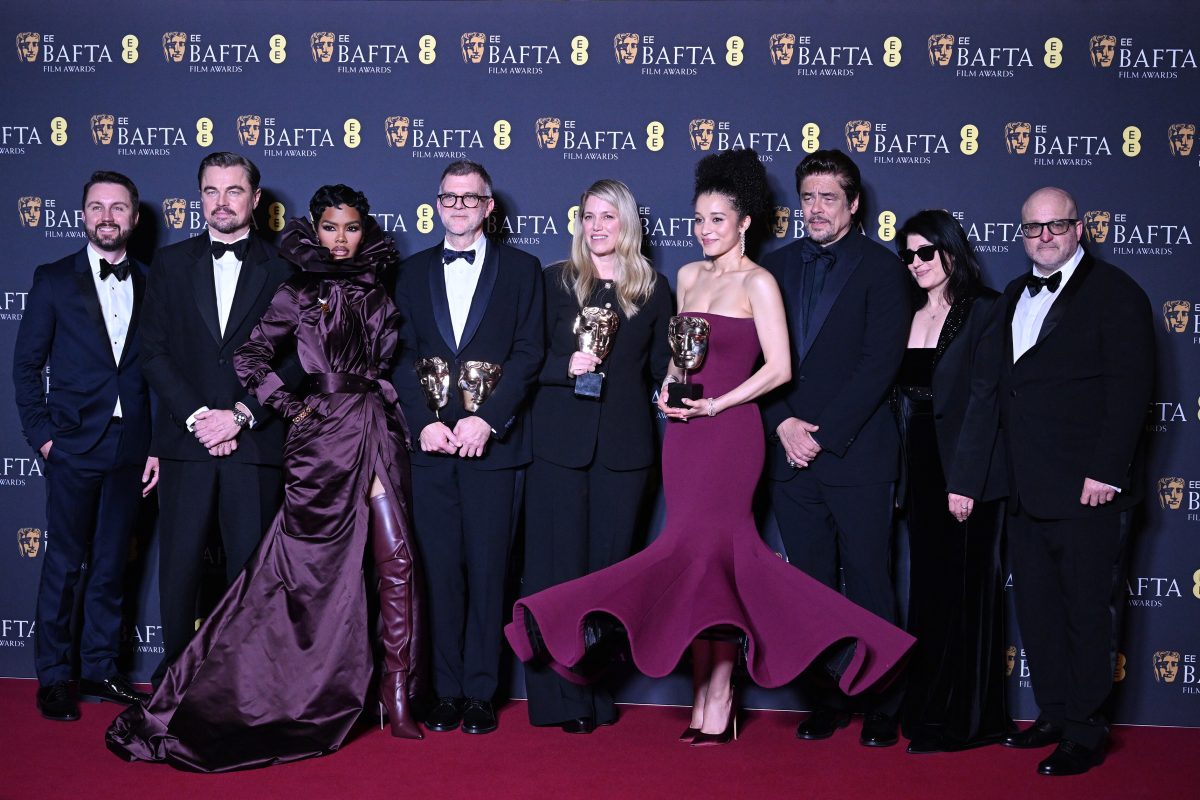
London's Royal Festival Hall played host to the 79th Bafta Awards, with Paul Thomas Anderson's 'One battle after another' the undisputed winner.
Presented by Alan Cumming and attended by Prince William and Kate Middleton, the evening honored a film that is part political thriller, part biting satire and part distorting mirror of the contemporary West.
With six awards, including Best Film and Best Director, the film literally dominated the evening. It also won Sean Penn the award for Best Supporting Actor, as well as Best Adapted Screenplay, Best Editing and Best Cinematography. A success that already makes it the favorite for the next Oscars.
The real surprise came in the Best Actor category: Robert Aramayo beat out favorite Timothée Chalamet, who won for I Swear, a social comedy about a young man with Tourette's syndrome. Also beaten were Leonardo DiCaprio (protagonist of One Battle After Another), Ethan Hawke, Michael B. Jordan and Jesse Plemons.
Best actress went to Jessie Buckley for Hamnet, which also won Best British Film. Sinners took three awards - Best Supporting Actress for Wunmi Mosaku, Best Original Screenplay and Best Score - while Frankenstein won in the costume, set and make-up categories. Best foreign-language film went to Sentimental Value, and best animated film to Zootropolis 2.
But it was 'One battle after another' that was the beating heart of the evening. Inspired by Thomas Pynchon's novel Vineland, the film features a neo-colonial dystopia that openly evokes Trump-era America. In a universe suspended between phone booths and social networks, power is dominated by white supremacism, detention centers and paranoid propaganda.
Protagonist Bob Ferguson, played, as we've said, by Leonardo DiCaprio, is a former revolutionary of the subversive group French 75, now a disoriented, ironic and decadent figure. His personal trajectory becomes the allegory of a generation that has lost its moral compass. Opposing him is Colonel Lockjaw, played by Sean Penn, the embodiment of an authority obsessed with purity and repression.
The film alternates between breathless chases and grotesque moments, mixing genres. Jonny Greenwood's soundtrack reinforces a permanent sense of anxiety. The camera glides between riots, deserts and suburbs, depicting an America where hatred has become a system.
The satire is frontal: walls, identity rhetoric, elitist secret societies. But Paul Thomas Anderson avoids pamphleteering and composes a deeply human tale, where the real battle is not only against power, but also to save bonds, feelings and dignity. The shadow of the Trump era looms large without ever being named: a sharp critique that uses fiction to speak of the present.
The Baftas often herald the Oscars. If the trend continues, London may already have written part of the Hollywood script. In the meantime, 2026 will be remembered as the evening when a political dystopia conquered the heart of the British film industry.
Between applause, surprises and standing ovations, Une bataille après l'autre demonstrated that cinema can still be both total spectacle and civic reflection. And that, even in an age saturated with images, a powerful story can transform an awards ceremony into a true cultural event.
(©GreenMe.it 2026 / Managing Editor: Julie Morgan- The Press Junction / Picture: Picture Alliance - Newscom - Rune Hellestad)