
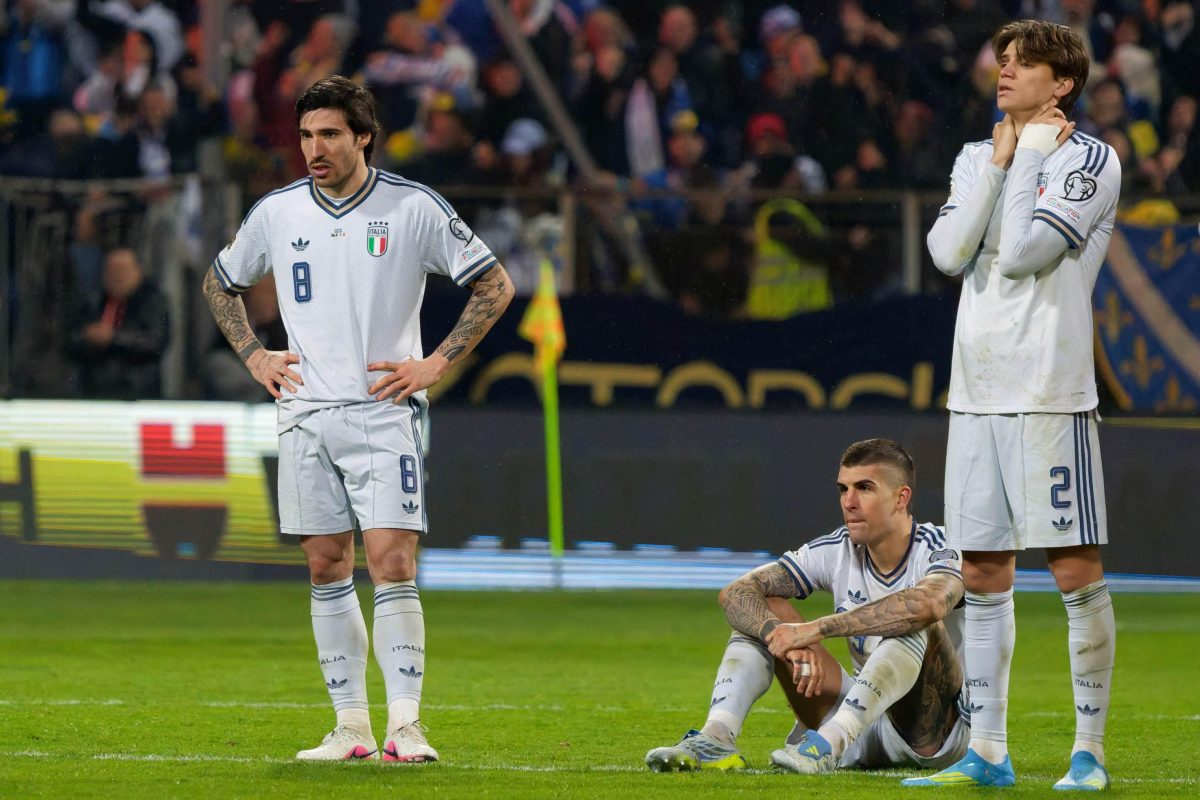
 © picture alliance / ipa-agency | Emmanuele Mastrodonato/IPA Sport
There's a very precise moment when you realize it's not just a defeat. That's when silence and bitterness replace anger, as if it has suddenly now become a predictable script. Italy loses to Bosnia following penalty kicks, stays away from the 2026 World Cup, and the feeling is no longer shock, but something else: a recurring nightmare. The third elimination in a row. The third missed opportunity. The third time a World Cup summer isn't for Italy, but for other countries.
There's little to say about the match itself. Italy takes the lead, then gets down to ten men because of a red card for Bastoni and begins to regress. Low defense, few ideas, visible fear. Bosnia takes over the initiative, equalizes and drags everything into penalty kicks. Those same penalty kicks that gave Italy a World Cup and an European Championship title and now, once again, deny the Italians access to a third World Cup in a row. Because yes, it ends as it seemed almost inevitable . Mistakes, downtrodden looks, little clarity: two misses and Bosnia gets to cheer. It's not just a sporting defeat, it's the picture of a fragile national team that fails to make its mark, even against opponents that are beatable on paper.
The generation without magic nights
But the real weight of this elimination isn't just sporting. It's cultural, emotional, generational. There are young people who have never seen Italy at a World Cup. Not once. Not a single summer wearing an oversized azure shirt, no penalty kick that makes you hold your breath, no square full of people after a goal. For them, the World Cup is a story from the past. It's Berlin 2006, told by their parents, it's the memory of Paolo Rossi told by their grandparents, it's something that only exists in movies. This is the generation without magical nights, raised between eliminations and vain hopes.
(...)
Of course, the 2021 European Championship also stands out in Italians' minds, a collective embrace after difficult years going through the Covid pandemic, the hope that it was the beginning of something new. Today, that hope feels distant. And above all, it feels even further away for those who don't have even one memory to cherish.
A system that no longer works
This can't go on like this. Three missed World Cups isn't an accident. It's a sign. A fundamental change of direction is needed, not only technically but also structurally. New ideas are needed, room for youth, a leadership that dares to rethink the whole system. It's not enough to appoint another national coach, it's not enough to wait for "the next batch."
The problem runs deeper. The soccer world is struggling to renew itself, young players are given few opportunities, the national team is losing its identity. And when that identity is missing, even the weight of the shirt becomes lighter. This was evident against Bosnia: little personality, little conviction, little hunger. A scenario the Italians have experienced far too often.
Italy is more than soccer
Perhaps in recent years - and even more so this year - Italy is discovering that it's more than just soccer. Because while soccer is "squeaking and creaking" (to put it mildly, looking at the European club tournaments), the "rest" of Italian sport - which has always been dismissed as second-rate - is experiencing one of its richest periods in its history. Italy is not just soccer and it's proving it with results few countries can match.
At the Paris 2024 Olympics, Italy matched a historical record with 40 medals, even improving the number of gold medals over Tokyo. A result that confirms broad growth in numerous disciplines. Added to this is the absolute record over the Milan-Cortina Olympic and Paralympic Winter Games, a sign of an increasingly competitive sports landscape, especially in swimming and skiing.
Cycling is back at the top with Jonathan Milan, who, after years, has brought Italy stage victories in the Tour de France again. In tennis, Jannik Sinner, for months the world number one and the figurehead of a generation that's not afraid of the international stage, reigns supreme. In MotoGP the successes are piling up, first with Pecco Bagnaia and now with Marco Bezzecchi, currently leader in the standings, on two (how could it be otherwise) Italian bikes: Ducati and Aprilia.
And then there's Formula 1, where the talent of Kimi Antonelli is emerging with vigor: he too is at the top of the championship and, at nineteen, is already a protagonist, with the certainty that he will keep the Italian people dreaming and the Italian national anthem ringing for years to come. (...)
A new sporting identity
All that, of course, doesn't erase the bitterness over yet another World Cup that we may follow as a "reserve". Or rather, not even as a reserve, but as an absentee. But it does change the outlook. Italy continues to win, continues to move, continues to produce champions. Only it's happening somewhere else. The danger, however, is that soccer will be left behind while the rest of the sports rush ahead.
Now, Italian soccer must decide if it wants to cling to the past or really start over, and also learn from other sports which are rising. Because young people deserve their own magic nights, and the right to make memories like older Italians have. But meanwhile, those emotions come from other jobs, other fields, other paths. And perhaps it's precisely there that Italian soccer should learn to look again.
(©Euronews 2026 / Managing Editor: Julie Morgan - The Press Junction /Picture: picture alliance / ipa-agency | Emmanuele Mastrodonato/IPA Sport)