
Society
Environment
Science
Weird & strange
Story of Tutankhamun's meteorite dagger reveals new secrets about Ancient Egypt
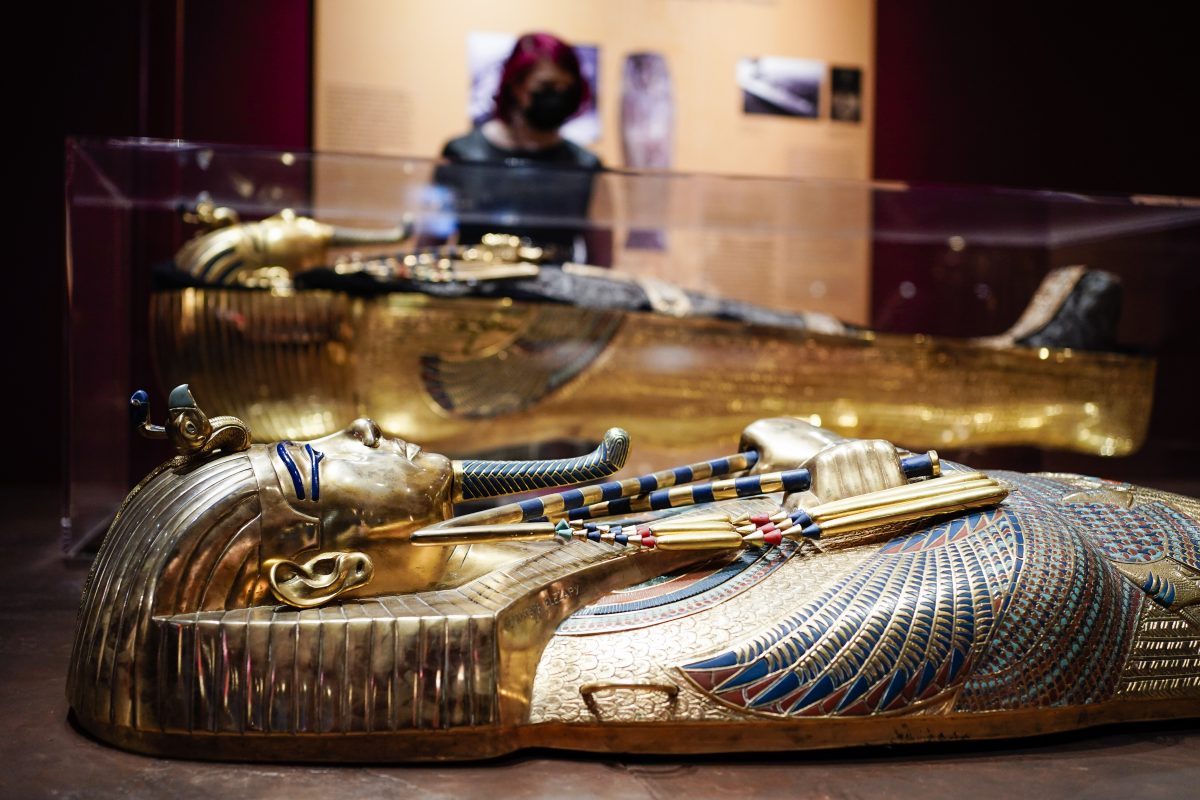 ©picture alliance/dpa | Uwe Anspach
Anyone who thinks about Ancient Egypt immediately envisions pyramids, golden sarcophagi and mummies shrouded in mystery. Yet some of the most stunning objects from the Egyptian civilization not only tell a story about Earth, but a story that begins much further away, among asteroids and drifting chunks of rock in space as well.
One such object is the famous dagger found in Tutankhamun' s tomb, a blade that has intrigued archaeologists and scientists for decades. We now know with certainty that this metal didn't originate in the subsurface of our planet. It came from the sky, in the form of a meteorite, and was transformed into a weapon worthy of a pharaoh more than three thousand years ago.
In recent years, new analyses have added valuable details to this story. They show how the craftsmen of the time were able to work with such a rare material and what path the blade may have taken before it ended up next to the young ruler in his tomb.
An extraordinary treasure hidden in the young pharaoh's tomb
Tutankhamun's worldwide fame stems from a discovery that changed archaeology forever. In 1922, British archaeologists led by Howard Carter located his tomb in the Valley of the Kings and came face to face with a virtually untouched tomb.
Inside the tomb lay an incredible amount of objects that were supposed to accompany the pharaoh into the afterlife. Jewelry, amulets, musical instruments, board games, objects designated for rituals and symbols of royal power filled the tombs. Among them, two extraordinarily beautifully crafted daggers also stood out.
One dagger had a golden blade, fully in keeping with the prestige of an Egyptian ruler. The other, however, had an iron blade, combined with an elegant grip and a scabbard decorated with gold.
At the time, that very detail was almost inexplicable. In fact, Tutankhamun's reign fell during the late Bronze Age, a period when iron was still extremely rare. The metallurgical techniques needed to melt iron ore required very high temperatures of over 1,500 degrees, difficult to achieve with the technology of the time.
So for a long time, the presence of that blade remained a archaeological mystery. The answer came thanks to modern science. Chemical analyses and metallographic studies have shown that the dagger's iron has a composition typical of iron meteorites.
The metal contains nickel and cobalt in proportions characteristic of asteroid fragments, a combination virtually absent in iron in terrestrial mines. In other words, this blade was made from a meteorite that fell on Earth.
For the Egyptians, such a material must have been something extraordinary. Metal fragments that fell from the sky were not only rare, but were probably seen as something special, almost sacred. In a culture where the pharaoh was considered a figure with divine ties, turning metal that fell from the sky into a royal object had enormous symbolic connotations.
New analysis reveals how the metal was worked
A 2016 study conducted by researchers at the leading technical university Politecnico di Milano definitively confirmed the dagger's meteoritic origin using advanced material analyses. In the following years, a group of scientists from the Chiba Institute of Technology in Japan went a step further. They conducted a new, non-invasive X-ray examination to better understand both the composition of the metal and how it had been worked by the artisans of Ancient Egypt.
The examination found several chemical elements in the blade, including iron, nickel, manganese and cobalt, in addition to traces of sulfur, chlorine, calcium and zinc that were concentrated in the darker areas of the surface. The most interesting discovery, however, related to the internal structure of the metal. The researchers found an unusual crosshatched crystal pattern called the Widmanstätten pattern, a kind of natural signature typical of iron meteorites from the octahedral category.
Many of these meteorites originated in the asteroid belt between Mars and Jupiter, a region of space populated by millions of rocky fragments. The presence of this structure also gave a clue as to how the metal had been worked. Egyptian craftsmen probably forged the meteorite at relatively low temperatures, below 950 degrees, preventing the destruction of the metal's crystalline structure.
A possible diplomatic gift between ancient empires
The story of the dagger, however, could be even more fascinating than it already seems. Some contemporary diplomatic documents, known as the Amarna Letters, describe exchanges between the great powers of the Near East in the 14th century BC. One of those texts mentions a special gift: an iron dagger with a gold sheath, sent to Pharaoh Amenhotep III by the king of the kingdom of Mitanni on the occasion of a royal wedding. Amenhotep III was Tutankhamun's grandfather.
Because iron was extremely rare at that time, many scholars consider it quite possible that the dagger mentioned in these diplomatic letters is exactly the object found in the young pharaoh's tomb. If this hypothesis is correct, it would mean that the weapon was not made specifically for Tutankhamun, but that it reached him as a precious dynastic legacy passed down within the royal family.
Today, the dagger is on display at the Egyptian Museum in Cairo and continues to fascinate researchers and visitors alike. It's one of those objects that show how closely intertwined human history is with that of the universe. A fragment of an asteroid that traveled through space for millions of years fell to earth, was picked up by human hands and transformed into a weapon intended for a pharaoh.
More than three thousand years later, that same blade still tells us a story that connects astronomy, archaeology and human ingenuity, reminding us that even the most ancient civilizations looked at the sky in wonder.
(©Meteoritics and Planetary Science via GreenMe.it 2026 / Managing Editor: Julie Morgan - The Press Junction / Picture: ©picture alliance/dpa | Uwe Anspach)