
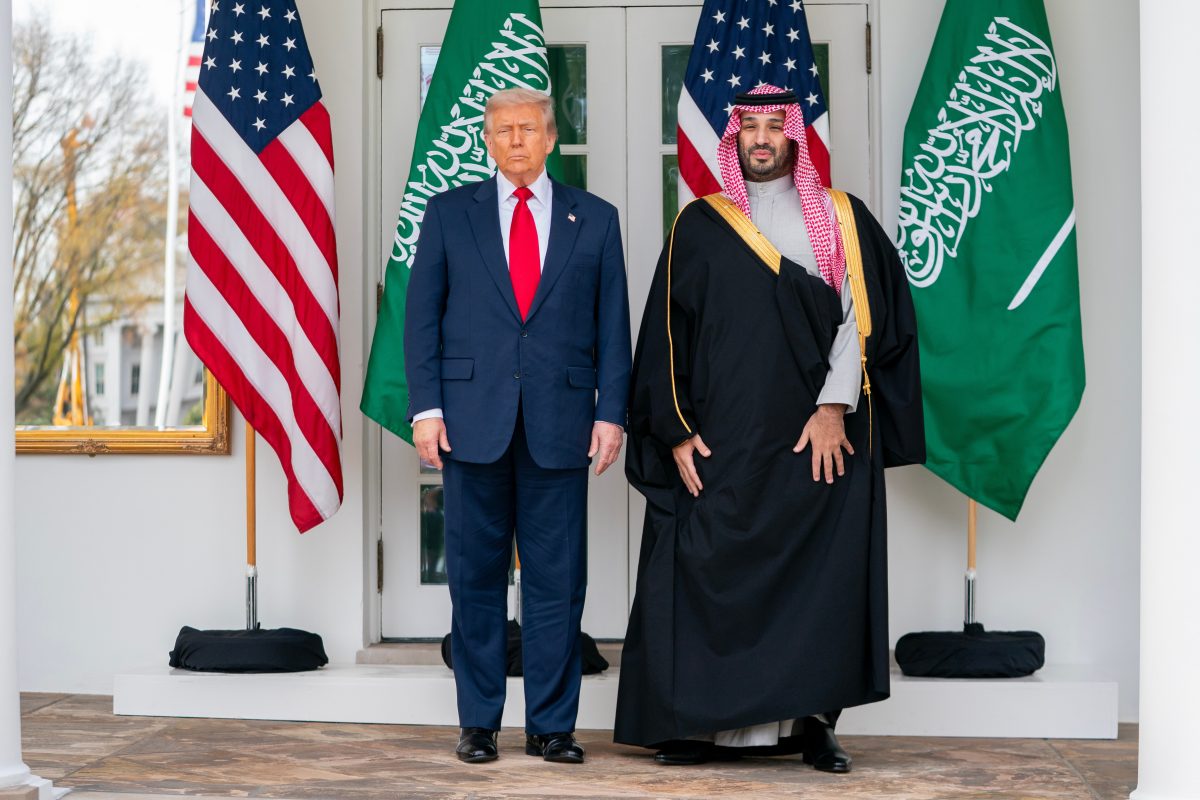
 ©picture alliance / Consolidated News Photos | Nathan Howard - Pool via CNP
The United States and Saudi Arabia have signed a new nuclear agreement that is officially intended for civilian nuclear energy, but is causing concern in Washington and the Middle East. The agreement involves a 30-year partnership under which U.S. companies will provide technology, expertise, and infrastructure for the construction of Saudi nuclear power plants.
The core of the deal is that Saudi Arabia, with U.S. assistance, will be able to expand its nuclear energy capacity to cover a portion of its electricity production. The country hopes this will allow it to burn less oil domestically and export more oil. For the U.S., the agreement is also economically and strategically significant: it is intended to secure American influence in the Saudi nuclear sector while preventing China or Russia from gaining a dominant role there, according to Reuters.
A step toward nuclear weapons?
The most sensitive issue is uranium enrichment. This technology is necessary to produce nuclear fuel, but it can also be scaled up to produce material for nuclear weapons. Under the deal, a two-year joint U.S.-Saudi study will first be conducted to assess whether an enrichment facility in Saudi Arabia is necessary. Only then could a U.S. president potentially give the green light for such a facility. While the agreement does provide for monitoring of enriched uranium and spent nuclear material, Reuters reports that it lacks the stricter safeguards that were included in previous agreements. This gap has drawn criticism. Democratic politicians warn that the deal lacks sufficient nonproliferation safeguards, and nuclear experts also fear that this will provide Saudi Arabia with a technological stepping stone toward developing its own nuclear weapon.
Review every two years
Under the deal, the cooperation will last for thirty years. Every two years, an assessment will be made to determine whether Saudi Arabia needs to continue importing fuel or requires its own enrichment capabilities; if the latter is confirmed, U.S. companies will be able to supply the infrastructure and centrifuges. Critics point out that the agreement does not include the strictest safeguards that Washington normally requires, such as the so-called “Gold Standard” ban on enrichment and reprocessing, nor does it provide for the strictest IAEA oversight through the Additional Protocol. As a result, Saudi Arabia would technically be on a path toward its own nuclear fuel cycle.
Concerning statements by the Crown Prince
Observers and non-proliferation experts cite Crown Prince Mohammed bin Salman’s historic statements as particularly concerning. In a 2018 interview with CBS, he said that Saudi Arabia would pursue a nuclear weapon if Iran were to build one. The defense pact between Saudi Arabia and nuclear power Pakistan also fuels the unease, as Islamabad has indicated that its nuclear capabilities would be available to Riyadh in an emergency.
Security concerns
Reactions in the U.S. are divided. Democrats and some Republicans believe the deal lacks sufficient security guarantees and gives Congress too little oversight. Secretary of State Marco Rubio says Washington will never enter into an agreement that poses a nuclear weapons risk. Nevertheless, criticism persists, especially since the deal also means that U.S. companies will play a key role in the expansion of the Saudi nuclear sector. Still, the deal isn’t off the table just yet: Congress has 90 session days to raise objections, but blocking it will be difficult due to the Republican majority and the high threshold for overruling a presidential veto.
Israel, too, is watching with suspicion. In Jerusalem, there is concern that a Saudi uranium program will encourage other countries in the region to pursue similar ambitions.
©picture alliance / Consolidated News Photos | Nathan Howard - Pool via CNP