
Society
Environment
Science
Invisible but always there: study reveals what really happens to cigarette butts in the ground
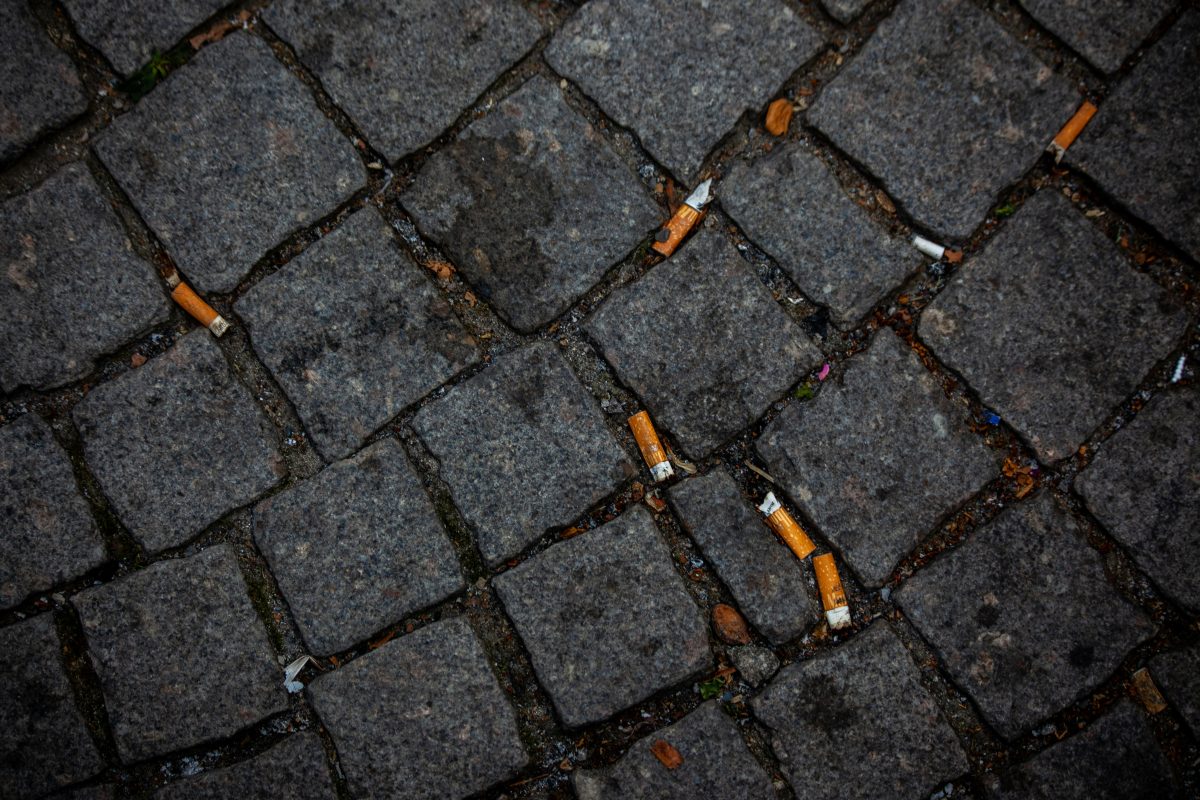 ©Jas Min via Unsplash
Some waste remains clearly visible, almost annoying because its presence is so obvious. And then there are others that follow the opposite path: they gradually disappear, blending into the background, disintegrating just enough to make us believe that the problem has been solved. Cigarette butts precisely belong to this second category.
We see them on the ground, on sidewalks, at the edge of gutters. Then the rain comes, cars go by, seasons change, and after a while they're gone. Or rather: we no longer see them. Because in the meantime, they've simply changed shape.
What happens to cigarette butts over time
A study that lasted almost ten years tracked the fate of thousands of discarded cigarette filters under real-life conditions, exactly as happens in front of our homes every day. Not in a sterile laboratory, but in the midst of earth, sand, grass, rain and sun. A patient, almost obstinate experiment that has observed what happens when we stop looking.
At first, everything seems to be going in the right direction. Within the first month, the butts lose a significant proportion of their weight, between 15% and 20%. The most superficial substances dissolve, are carried away by water and disperse into the soil. A rapid, almost reassuring transformation.
Then the pace changes, slowing and stretching. Over the next two years, the total loss is barely 30-35%. The rest remains there, as if in suspense. And this is where the context comes into play: soil type, presence of micro-organisms and humidity. In more 'living', nutrient-rich soils, something more happens. After ten years, degradation can reach 84%. But this percentage only tells part of the story. Because even when the material shrinks, it doesn't really disappear.
The problem lies in the very structure of the filter, which is made of cellulose acetate, a plastic designed to resist. This is what makes the filter effective, but also incredibly slow to degrade. The bacteria do what they can, but it's not enough. So, while the cigarette butt changes appearance, it continues to remain present.
From filter to microscopic fragments
If we look at what's happening on a microscopic scale, the transformation becomes even more interesting, and also more worrying. New filters are made of compact, tightly interwoven fibers. Over the years, these fibers become deformed, broken, coiled and mixed with soil and organic residues.
At a certain stage, they no longer resemble cigarette butts at all. In their place are tiny particles, some measuring just a few micrometres, which the researchers have described as novel structures, never before observed in this context: a kind of hybrid residue, halfway between plastic and organic matter.
This is where the real change of perspective takes place: the waste is no longer recognizable, but much more diffused. It's fragmented, it's occupied space, it's integrated into the ground. And it's not neutral. Even after years, these residues retain biological effects. Freshly discarded cigarette butts are more toxic, but those that have 'aged' also retain a certain activity. More recent studies have shown that the microfibers released by filters can interact with human cells, provoking inflammatory responses under laboratory conditions.
This doesn't mean that there's a direct and immediate effect on our daily lives, but it does make one thing very clear: these particles are not simply inert. They remain active, even when they become invisible. And this is perhaps the most difficult point to accept. We're used to thinking that what we can no longer see no longer exists. In the case of cigarette butts, exactly the opposite is true: the less we see of them, the more they're dispersed.
Source: Environmental Pollution
(©GreenMe.it 2026/Managing editor: Selma Keshkire - The Press Junction/Picture: Jas Min via Unsplash)