
 ©picture alliance / NurPhoto | STR
Poland has opened a production line for the Hornet, a domestically developed long-range attack drone described as Poland’s answer to the Iranian Shahed. The facility in Sochaczew, west of Warsaw, is a joint venture between the state-run ITWL and the Boryszew industrial group.
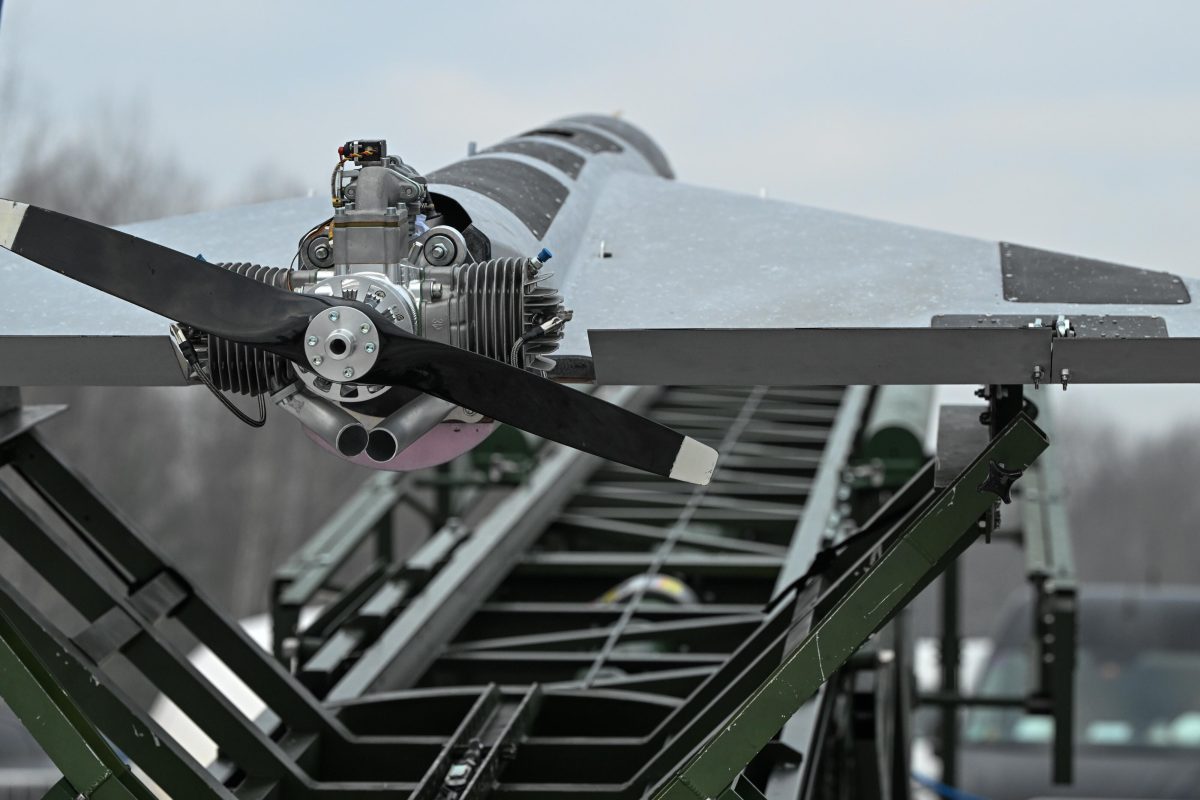
The Hornet is a so-called one-way attack drone—or kamikaze drone— that does not return after its mission. The aircraft features a delta-wing configuration, a gasoline engine, and a pusher propeller at the rear. The drone is 2.6 meters long, has a wingspan of 2.2 meters, and weighs approximately 85 kilograms. The base model has a range of 400 kilometers, but versions with different equipment can reach up to 1,200 kilometers, according to the manufacturer. The attack version carries a warhead weighing 16 to 20 kilograms. Foreign media emphasize that the long-range version puts Moscow within range.
“Poland must have its own Shahed and its own deep-strike capability,” said Deputy Defense Minister Cezary Tomczyk at the presentation on July 9. By retaining the design rights within the ministry, Poland can produce the drone independently and adapt it as battlefield requirements change. Series production is scheduled to begin in 2027. The factory is ultimately expected to be capable of building up to 1,000 drones per month. For now, a pilot series is being produced pending the necessary government license.
In addition to the attack version, the Hornet PL-OWA, an unarmed variant has also been developed—the PL-AT-1— which serves as a target drone to simulate Shahed-like threats during air defense exercises.
The project is part of a broader Polish effort to introduce unmanned systems on a large scale. To this end, the Ministry of Defense has established an Autonomous Systems Center to align military requirements with research and domestic production. Although no final purchase contracts have been signed yet, the opening in Sochaczew marks a concrete step toward sovereign industrial capacity for the mass production of long-range drones. According to Wojciech Kowalczyk, chairman of Boryszew, the focus is not on maintaining large stockpiles in peacetime, but on the ability to quickly scale up production and flexibly adapt the design.
The Hornet is thus a symbol of a shift in European defense strategy: from expensive, high-end cruise missiles to inexpensive drones that can be deployed in large numbers. Europe lags behind Russia and Iran in this regard, but Poland aims to close that gap with the Hornet.
©picture alliance / NurPhoto | STR - FEBRUARY 19: View of the PLargonia long-range unmanned aerial drone (UAV) on its catapult launch system during open tests of unmanned weapon systems at the training ground of the Military Institute of Weapons Technology (WITU) in Zielonka (Poland) on February 19, 2026. Developed by the Institute of Air Force Technology (ITWL).