
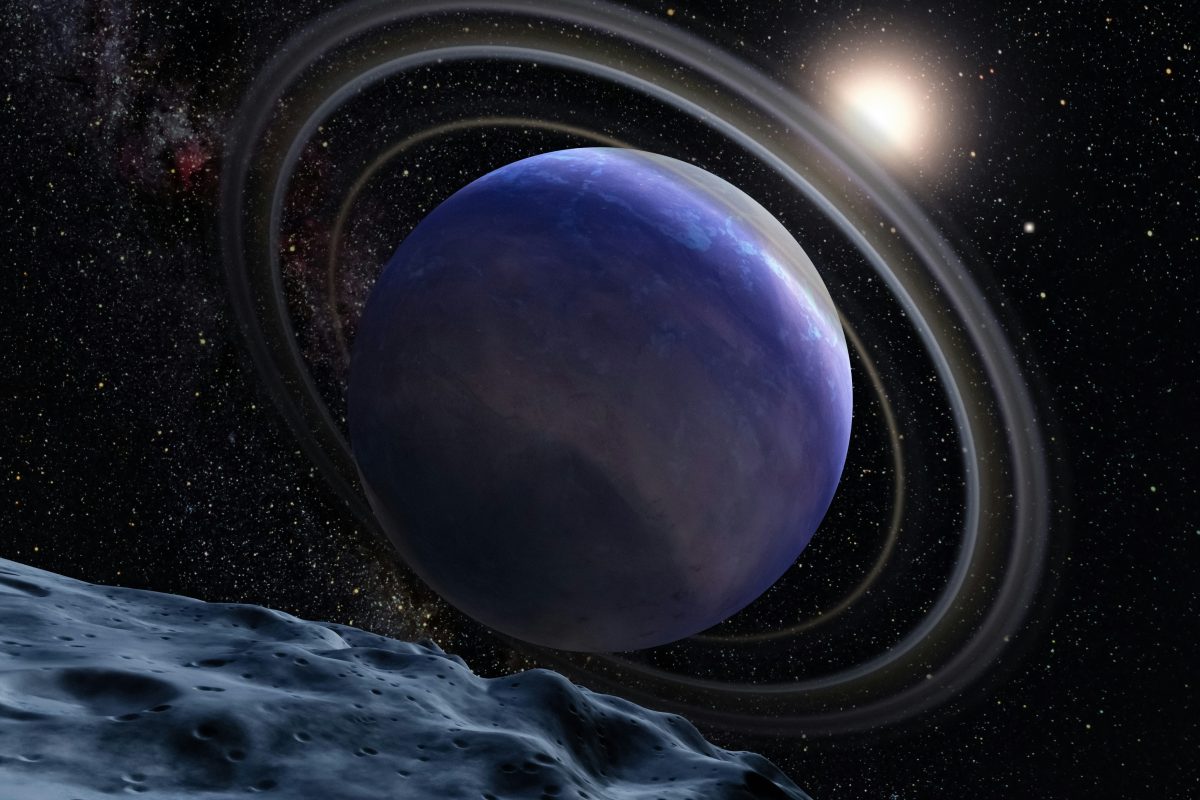
 ©NASA Hubble Space Telescope via Unsplash
Not all planetary systems are like ours. Scientists from the European Space Agency (ESA) have just discovered one that overturns all current theories on planet formation: the system around the star LHS 1903 is, in fact, 'inverted', with rocky planets further away from the star.
Astronomers have uncovered this unusual planetary system thanks to the CHaracterising ExOPlanet Satellite (Cheops), revealing that the most eccentric and distant planet could be rocky and possibly 'younger' too. It would evolve in a different environment from that of the other planets orbiting the star.
What we knew so far
In our planetary system, known as 'solar' (the planets orbiting the star Sun), the eight planets fall into two categories: rocky and gaseous. More precisely, the inner planets closest to the Sun - from Mercury to Mars - are rocky, while the outer planets - from Jupiter to Neptune - are gaseous.
This general pattern, whereby planetary systems form with rocky planets closer to the star, followed by gaseous planets on the periphery, has been commonly observed throughout the Universe. This is what current theories of planetary formation predict, and what observations have largely confirmed.
What astronomers have just discovered
The planetary system surrounding the star known as LHS 1903, together with the newly-discovered satellite, could revolutionize our understanding of planet formation. It's organized 'backwards', with rocky planets further away and younger.
The story goes back a long way, however: LHS 1903 is a well-known M-type red dwarf, colder and less luminous than our Sun, around which three planets seem to orbit, the closest being rocky and the next two gaseous. Until recently, everything seemed 'normal'.
After re-examining the Cheops satellite observations, astronomers discovered a fourth, smaller planet, the furthest away from LHS 1903. However, a more detailed analysis showed that it was a rocky planet.
Theories on the Universe turned upside down
This discovery truly challenges established theories on planet formation: Up until now, we've always believed that planets formed from disks of gas and dust (protoplanetary disks), coalescing into planetary embryos more or less simultaneously.over millions of years into planets of various sizes and compositions.
However... This 'unusual" system could have formed in a completely different way: the planets could, in fact, have appeared one after the other, rather than all forming at the same time. "That makes it an inverted system," explains Thomas G. Wilson, first author of the study, "with a rocky-gazy-gazy order, then rocky again. In principle, rocky planets don't form that far from their parent star".
This conclusion raises another complication: this little rocky planet seems to have formed and evolved in a very different environment from the others.
"When this outer planet formed, the system may already have exhausted its gas, considered vital for planetary formation," explains the expert. "And yet, here is a rocky little world that defies all expectations. We seem to have found the first evidence of a planet that formed in what we call a gas-poor environment."
In other words, this small rocky world is either an exceptional anomaly, or the first evidence of a trend of which we had no idea before. Either way, its discovery demands an explanation that goes beyond our usual theories of planet formation. (...)
"Ultimately," say the scientists, "these discoveries help us to understand how our own Solar System fits into the vastly diverse family of planetary systems. And they lead us to question the 'special' nature of the order of planets we teach children, and the possibility that it is in fact our Solar System that is truly 'unusual'".
Sources: ESA / Science
(©GreenMe.it 2026/Managing editor: Julie Morgan - The Press Junction/Picture: NASA Hubble Space Telescope via Unsplash)